In brief
- Oily skin naturally makes more sebum. That is partly down to genetics, and the rest you can keep well under control.
- Skin can shine and be dehydrated at the same time, and make extra sebum precisely because of that. Which of the two it is for you, we find out in the skin analysis for €69.00.
- With cleansing, peels and microneedling we make your pores less noticeable. Nobody can make them permanently smaller.
- Stripping the oil backfires. Cleansing gently twice a day and using a light cream does more than ten mattifying products.
Written by Nilay, owner and beauty therapist at Moons BeautyUpdated on
What is oily skin exactly?
Sebaceous glands make a thin layer of oil, and that layer protects your skin. It keeps moisture in and irritants out. With oily skin those glands are a little more active, especially in the T-zone, where you have the most of them per square centimetre.
You recognise it by shine that comes back within a few hours, by pores that stand out around your nose and cheeks, by skin that feels firm and by make-up that slips. Blackheads often come with it, because sebum and dead skin cells together block a pore. If those bother you a lot, read about blemish-prone skin too.
There is an advantage too: oily skin holds on to more of its own moisture and protection, and on average gets fine lines later. That is why we work towards the sebum spreading more evenly over the day, while that protection stays.
Oily, or actually dried out and oily because of it?
This is where most advice goes wrong. That's why we start almost every appointment with it.
Oiliness is about sebum, moisture about water in your skin. Those are two separate things, and you can have both at once: skin that shines and still holds too little moisture. In the mirror you only see the shine, so you usually buy something mattifying for it.
What is usually going on then is a damaged skin barrier, often from cleansing too harshly or using too many active products. Moisture evaporates faster than your skin can replace it, and your skin plugs that leak with an extra portion of sebum. So the harder you strip the oil, the more you shine.
Making that distinction is the most important step. Truly oily skin benefits from deep cleansing, acids and sebum regulation. Dehydrated skin that overcompensates first needs calm and hydration, and only then acids. You can read how we look at that under skin analysis.
- If your skin feels tight straight after washing and shines again an hour later, a lack of moisture is playing a part
- If fine lines appear when you gently pinch your cheek while your skin feels oily, that also points to too little moisture
- If your skin feels oily and at the same time rough or flaky, the barrier is probably damaged
- If a serum that used to be fine now stings, your barrier is struggling for the moment
- If the shine stays even and your skin otherwise feels supple, you probably simply have oily skin
Combination skin oily in the middle, dry around the edges
With combination skin your forehead, nose and chin shine, while your cheeks feel normal or even dry. It is one of the most common skin types. It only goes wrong when you put one product on your whole face, because then you are always doing too much or too little somewhere.
The solution is simpler than it sounds. You cleanse the same gentle way everywhere and care for each zone separately: a light gel on your T-zone, a richer cream on your cheeks and a clay mask only where you shine. We work the same way in the salon. During a Full cleansing we clear out your T-zone and calm the drier areas with a different mask. If your cheeks stay tight, read about dry skin too.
Where that shine comes from
Part of it is fixed and part of it is in your own hands. That second part is where you can almost always gain the most.
Genetics
How many sebaceous glands you have and how active they are is largely fixed in your genes. You don't need to change that anyway. What you can influence is how quickly your pores fill up.
Hormones
Hormones stimulate the sebaceous glands. That's why you shine more during puberty, in the second half of your cycle, after stopping the pill and sometimes around the menopause. Little sleep or a lot of stress shows in your T-zone too.
Heat and season
Sebum becomes thinner the warmer it gets and then flows out of the pore more quickly. That's why you shine in July and notice little of it in January. Sunbeds, saunas and hot showers do the same.
Cleansing too harshly
Foaming cleansers with sulphates, toners with alcohol and daily scrubs strip away your protective layer. That feels wonderful for twenty minutes, and then your skin makes up the shortfall. With this skin type, this is the mistake we see most often.
Products that don't suit
A cream that is too rich weighs your skin down and blocks pores. A product that dries out too much provokes more sebum. For almost everyone with this skin, light, moisturising care without heavy oils works best.
Powdering again and again
Powder absorbs sebum and then becomes a layer itself that seals the pore. By the afternoon you see that as patchy make-up and larger-looking pores. Blotting and touching up thinly works better than a third layer.
Treatments for oily skin at Moons
We work on two fronts at once. We empty your pores and keep them empty, and we repair the barrier so that your skin no longer has to overcompensate. We decide the order together in the skin analysis.
Full cleansing
€75.00This is the foundation. We cleanse twice, work with mild acids and steam, and then remove the blockages by hand. A cooling hydrojelly mask finishes it off. Pores that are empty look finer straight away.
60 minutesevery 4 to 6 weeksViewGlow peel 23%
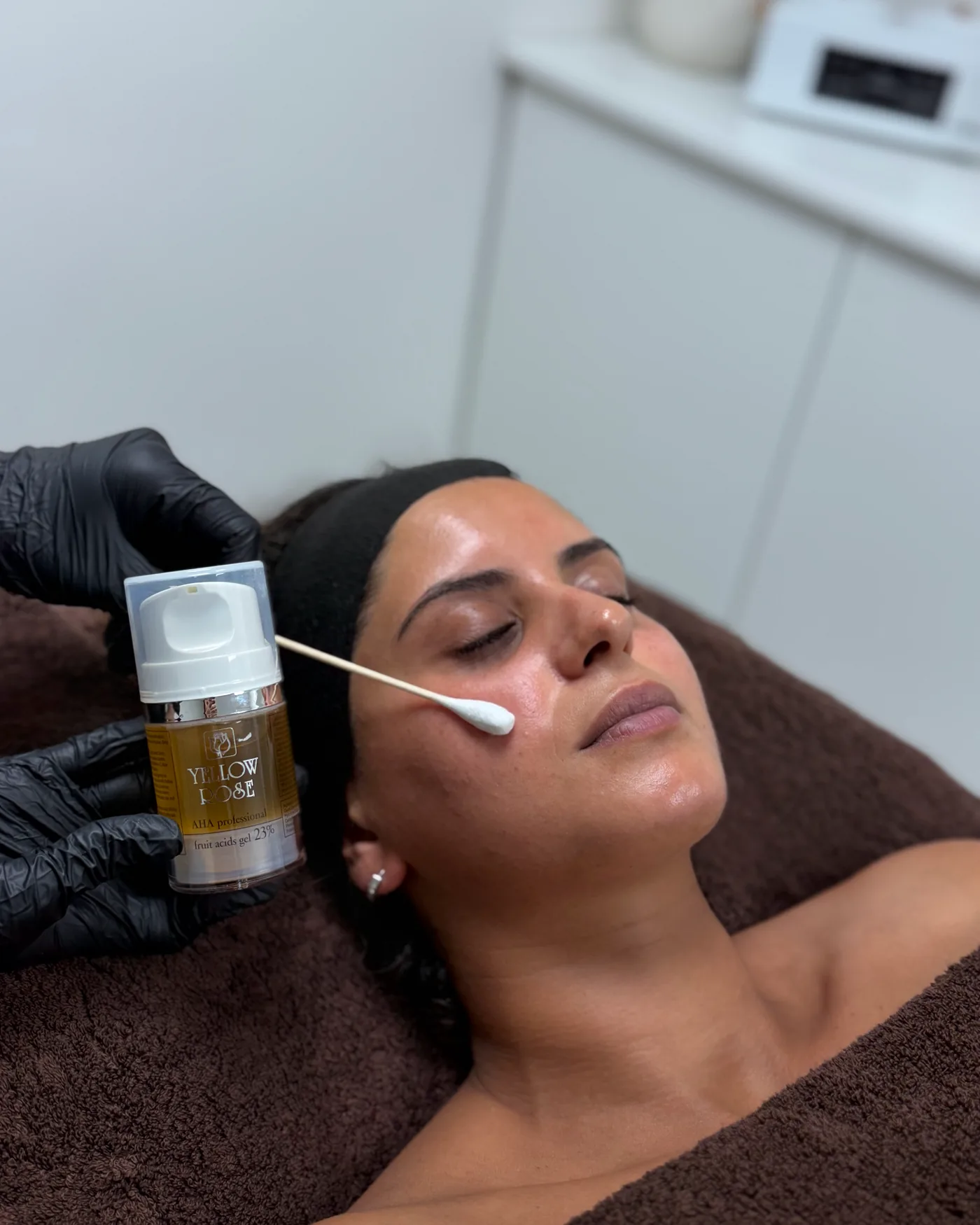
€79.00Fruit acids loosen dead skin cells and make the wall of the pore smoother. That lets sebum out more easily, and the pore clogs up less quickly. After a few sessions your complexion looks more even and less rough.
50 minutes4 to 6 times, every 3 to 4 weeksViewNiacinamide+
€89.00Microneedling with ten per cent niacinamide, the active ingredient that helps regulate sebum production and visually refines pores. If shine and visible pores bother you most, this is our first choice.
50 minutes4 to 6 times, every 4 weeksViewHydra treatment
€79.00Moisture for oily skin sounds contradictory, and yet it's true. Hyaluronic acid brings moisture back without weighing the skin down, which gives your skin less reason to make extra sebum. This treatment often brings calm the fastest.
60 minutesevery 4 weeksView
If you're short on time, the Quick cleansing is the compact version of the cleanse. All prices and times are on the prices page.
Which treatment suits your skin?
Each treatment works on something different, and the downtime differs too.
| Topic | Works mainly on | With sensitive skin | Afterwards | Usual course |
|---|---|---|---|---|
| Full cleansing | Full pores and blackheads | Yes, this is the gentlest choice | Clean straight away, you can carry on right afterwards | Every 4 to 6 weeks |
| Glow peel 23% | Enlarged pores and a rough texture | After talking it through, we start milder | Light flaking, two to three days | 4 to 6 times, every 3 to 4 weeks |
| Niacinamide+ (microneedling) | Shine, visible pores and redness | Yes, calming by nature | Red for one to two days | 4 to 6 times, every 4 weeks |
| Hydra treatment | Skin that shines and feels tight | Yes, especially then | Plumper straight away, and you simply carry on | Every 4 weeks |
If you can't decide between two treatments, book the first skin appointment. Then we choose together, based on what your skin shows that day.
Making pores smaller, is that really possible?
They won't become permanently smaller. The diameter of a pore is fixed by your genetics and is linked to how active the sebaceous gland beneath it is. If a cream, mask or treatment promises that the opening will become permanently smaller, it promises too much.
What we can do is make them stand out clearly less, and in the mirror that comes down to the same thing. A pore catches the eye because it is full, because its edge is rough and because the skin around it has lost firmness. You can influence all three.
We empty them with a deep cleanse, make the edge smoother with fruit acids and build firmness with microneedling. After four to six sessions most people say their skin looks smoother and that pores are less noticeable in daylight. What that looks like, you can see in the results.
Make-up that stays put on oily skin
If your make-up disappears within three hours, that is rarely down to your foundation. Usually the layer underneath is missing. Skin with too little moisture makes sebum all day long and pushes your make-up away with it. A light, moisturising cream five minutes before you start often does more than a pricier primer.
The order helps too. First you apply sun protection and let it sink in for a moment. Then comes a thin layer of foundation, and you set only your T-zone with powder. You touch up by blotting. After a peel you wear no make-up for twenty-four hours, after microneedling preferably for two weeks. Anything else that applies around an appointment is covered under practical information.
When does your skin become calmer?
Your sebum production doesn't change in a week. This is the pattern we see most often in the salon.
The same day
Clean and matte, and that's still temporary
Straight after a cleanse your skin is matte and your pores feel empty. That comes from the removal itself, because your sebum production is still the same. Some people even shine a little more the next morning. That says nothing yet about the final result.
Week 1 to 2
The barrier recovers
If you adjust your routine at home, this is where you notice the first real difference. Your skin no longer feels tight after washing and the shine only builds up later in the day. If you used to cleanse too harshly, you make the biggest leap in these two weeks.
After 4 to 8 weeks
Pores are less noticeable
After two or three treatments you see a smoother texture, fewer blackheads and pores that fill up more slowly. Your make-up stays on noticeably longer. Take a photo in side lighting at the start, because you can hardly see a better texture in the mirror.
After 3 to 4 months
The result of the course
Then we put your starting photo next to it. The amount of sebum is usually a little lower and, above all, more evenly spread. Your skin stays oily, and that is exactly the idea: you keep the protection and lose the excess.
After that
Moving with the seasons
In summer you shine more than in winter, even after a successful course. With maintenance every six to eight weeks and a routine you adjust twice a year, the picture stays stable.
What does it cost to treat oily skin?
You pay per treatment, so you're not tied to anything. A course costs roughly the amounts in this table. On top of that comes the first skin appointment for €69.00, because that's where we start.
| Treatment | Per session | Usual course | Full course (estimate) |
|---|---|---|---|
| Full cleansing | €75.00 | 3 to 4 sessions | €225.00 to €300.00 |
| Glow peel 23% | €79.00 | 4 to 6 sessions | €316.00 to €474.00 |
| Niacinamide+ | €89.00 | 4 to 6 sessions | €356.00 to €534.00 |
| Hydra treatment | €79.00 | 3 to 4 sessions | €237.00 to €316.00 |
See this as a guide. How often you need to come depends on your skin and on what you do at home. Cosmetic treatments are not covered by insurance. The current prices are on the prices page.
The routine that really reduces the shine
This routine is shorter than you think and mainly asks that you stick with it. We send you home with a list that suits your skin and the time you have in the morning.
Morning
- Rinse with lukewarm water or a mild gel cleanser, without your skin squeaking afterwards
- Skip the toner with alcohol, and choose one with niacinamide instead
- Use a light, moisturising cream, on your T-zone too
- Finish with matte sun protection SPF 30, which doubles as a base under make-up
Evening
- Double cleanse if you wear make-up or sun protection: first an oil or balm, then your gel cleanser
- Use a product with salicylic acid two to three evenings a week, which works inside the pore itself
- Alternate that with an evening without an active product, so your barrier can recover
- Finish with a light cream or a gel with hyaluronic acid, even if your skin feels oily
A clay mask is fine, at most once a week and only on the zones that shine. Rinse it off as soon as it turns matte. If you let it dry until it cracks, you dry out exactly that spot. If you're unsure about your current products, send a photo of the packaging along through the skin quiz.
Good to know about oily skin
Oily skin needs a day cream too
Oil and moisture are two different things. If you skip the cream, your skin loses moisture and responds by making more sebum. A light, moisturising formula is the core of the approach for this skin type.
Cleansing gently twice a day is enough
Every time you strip the oil, you remove your protective layer and your skin tops it up with extra sebum. If you wash more often, within a few weeks you shine more than before.
Alcohol in a toner only mattifies for a moment
Alcohol makes sebum and moisture evaporate at the same time and gives you a matte feel for twenty minutes. After that more comes back than was removed, and your barrier gets damaged. Choose a toner with niacinamide instead.
Heat makes sebum more fluid
A pore has no muscle, so it can't open or close. Heat makes sebum more fluid, so the pore drains, and the skin swells slightly. So steaming does work, just not the way you might think.
Lines often show later on oily skin
Oily skin holds on to more of its own moisture and protection. Many people find that fine lines become noticeable later than with dry skin. What helps against ageing for every skin type is daily sun protection.
When to see your GP first?
See your GP first if you also get deep, painful inflammations, if your skin changes sharply in a short time for no apparent reason, if red, flaky or itchy patches appear around your nose, eyebrows or hairline, or if the shine comes with heavy hair growth or an irregular cycle. A doctor needs to look at that, and we don't comment on it ourselves. If you use medication that makes your skin more sensitive, let us know beforehand. If you are pregnant or breastfeeding, we keep to a mild cleanse and hydration.
Frequently asked questions about oily skin
Where can you have oily skin treated in Enschede?
At our salon, Moons Beauty, at Haaksbergerstraat 302 in Enschede. You can park for free right outside. The first appointment is a skin appointment of sixty minutes, with an analysis, a treatment that suits what your skin needs that day and advice for home. After that you decide for yourself whether to continue with a course.
How do I know whether my skin is oily or actually dried out?
Look at the difference between shine and tightness. Truly oily skin shines evenly and otherwise feels supple. Dehydrated skin shines too, but feels tight after washing, sometimes feels rough or flaky and gets irritated by products that used to be fine. That second skin needs hydration first, because stripping the oil backfires there.
Can you make enlarged pores smaller?
Making them permanently smaller isn't possible, because their size is fixed by your genetics. You can make them stand out a lot less, though. Pores catch the eye when they are full, when the edge is rough and when the skin around them loses firmness. With deep cleansing, fruit acids and microneedling we tackle all three.
Does washing more often help against oily skin?
No, usually it works exactly the other way round. Every time you strip the oil, you remove the protective layer and your skin tops it up with extra sebum. Cleansing gently twice a day is enough. The same goes for scrubbing and toners with alcohol. They feel clean, and within a few weeks you shine even more.
Do I need a day cream with oily skin?
Yes. Oil and moisture are two different things, and skin with too little moisture actually makes more sebum. Choose a light formula, preferably a gel or fluid, and use it on your T-zone too. If your skin feels tight after washing, that is the clearest sign that moisture is missing.
Which treatment helps best against shiny skin?
That depends on what dominates for you. If your pores are full, we start with a Full cleansing for €75.00. If the texture is rough, the Glow peel 23% works. If it's mainly shine and visible pores that bother you, we choose microneedling with niacinamide. And if your skin shines while feeling tight at the same time, we start with the Hydra treatment.
I have combination skin, what should I use where?
Cleanse your whole face the same gentle way and then care for each zone separately. On your forehead, nose and chin you use a light gel or serum, on your cheeks a richer cream, and a clay mask only where you shine. With one product over your whole face, with this skin type you are always doing too much or too little somewhere.
Why won't my make-up stay put?
Usually because your skin keeps making sebum all day, and that often goes together with too little moisture underneath. Apply a light cream and give it five minutes. Then use a thin layer of foundation and set only your T-zone with a little powder. Touch up by blotting, because powder on sebum creates exactly that patchy layer.
How long before I see a difference?
On the first day you are matte from the cleanse itself. Your sebum production hasn't changed yet. After one or two weeks with an adjusted routine you notice that the shine comes later in the day. After two or three treatments, so after about six to eight weeks, your pores are less noticeable.
What does a treatment for oily skin cost at Moons Beauty?
A Full cleansing costs €75.00, the Glow peel 23% €79.00 and a Hydra treatment €79.00. Microneedling with niacinamide costs €89.00. The first skin appointment with analysis and treatment costs €69.00. You pay per session, so you're not tied to a course.
Treatments for oily skin